When Person of Interest introduced “the Machine” in 2011 – a system that used cameras, phones, databases, and human behavior to piece together predictions of what would happen next – it was pure science fiction. Fifteen years later, the series suddenly makes sense. We may not have such a Machine yet or, just as in the series, we may simply not know about it. What we do know is that a surprising number of its individual capabilities already exist.
In the end, the series did not place one machine opposite humanity, but two: the Machine, whose creator tried to limit and channel its power, and the Samaritan, which people brought into operation precisely because they believed that an intelligence capable of seeing more than they could should govern society. In the end, they themselves became the ones carrying out its will.
It Is 2026. So What Do We Actually Have?
We have neither the Machine nor the Samaritan, but companies already sell their individual capabilities. Palantir can connect data from different systems and sensors into a shared picture and support decision-making based on it. Through Lattice, Anduril connects sensors, autonomous systems, and effectors directly in the physical world. Clearview AI can compare a human face against a database containing tens of billions of images from the public internet. None of these companies has built the Machine or the Samaritan, nor do they claim to be building anything of the kind.
But the more uncomfortable point is this: capabilities that fifteen years ago belonged to a single television supermachine now exist as routinely offered products from real companies. And perhaps that is more interesting than one omniscient system. We do not need one machine that sees everything. It is enough for individual systems to see enough, and for their data to be connectable. The question is no longer whether such layers can be connected. They can. The question is who is allowed to connect them, with what data, and for what purpose.
When Does a Recommendation Become Power?
People tend to imagine power as a collection of unpleasant commands and prohibitions. Someone decides; someone else obeys. With AI, it may be far less obvious. A system does not have to forbid or order anything. It only has to start making recommendations so accurately that we stop questioning them.
At that point, the boundary between advice and decision begins to blur. Formally, a human can remain “in the loop,” can retain the final word, and can even have the option to ignore the system. But the ability to reject a recommendation does not necessarily mean real independence if, most of the time, the human merely confirms what the system has proposed.
Once a system consistently arrives at the correct decision more often than a human does, rejecting its recommendation begins to look almost irresponsible. Research uses the term automation bias for similar behavior: people tend to rely too heavily on automated recommendations, especially when they are working under time pressure, dealing with a complex problem, or have no easy way to verify the system’s output.
And this is precisely where the nature of the relationship changes. Not because AI has taken control, but because people begin adapting their own decisions to what the system—or the organization behind it—evaluates and labels as safe, reasonable, and optimal according to the goal it is pursuing. That goal may be the safety of the majority, institutional efficiency, risk minimization, or profit. But what is optimal for the system is not automatically optimal for a particular person. Such “optimization” can have unpleasant, even fatal, consequences for an individual.
Maybe AI Will Never Have to Take Power
The popular idea of “AI taking control of humanity” may be asking the wrong question entirely. Perhaps no dramatic moment of takeover will ever come. No switching humans off. No announcement that, from now on, the system is in charge.
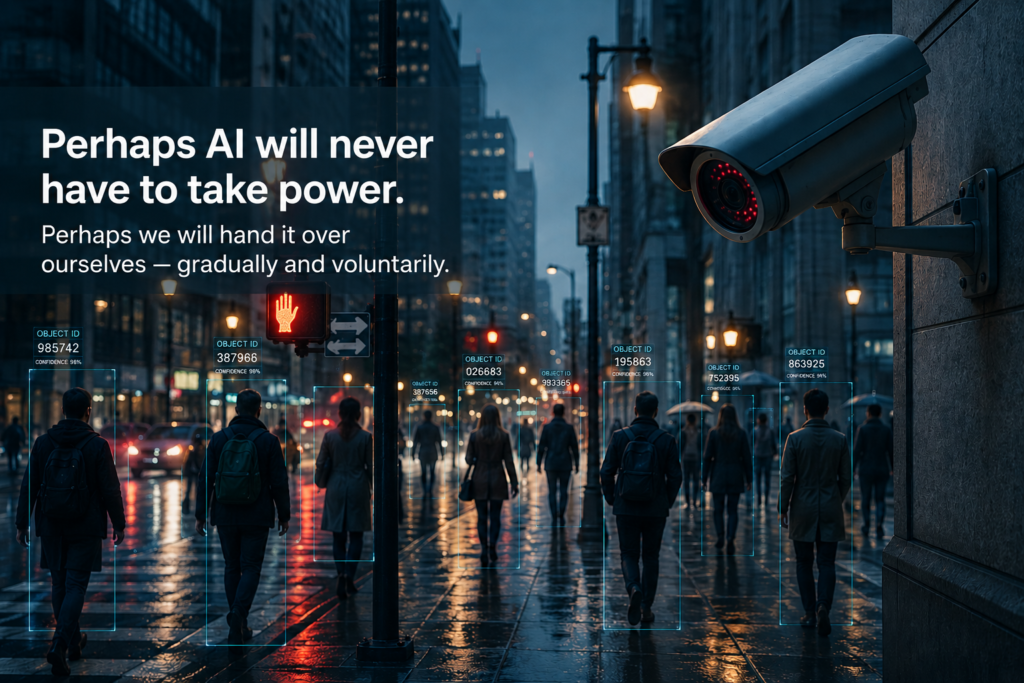
Perhaps we will hand that power over ourselves – gradually and voluntarily.
Not because we fail to see the possible consequences, but because it will make sense. AI will be faster, it will be able to work simultaneously with volumes of data that no human has a chance to process, and in many situations it may achieve better results. The more often that proves true, the harder it will become to reject its recommendation. Disobeying the system may then look less like an expression of human autonomy and more like an unnecessary risk.
And that brings us to an uncomfortable question:
What does human control mean if a person can technically decide differently, but almost never has a good reason to do so?
In theory, a human may remain the final person to confirm a decision. In practice, however, that person may be working under time pressure, with incomplete information and data so complex that it cannot be evaluated in time without the system’s help. Add human biases, fatigue, routine, and a gradually increasing trust in a tool that has repeatedly been more accurate than the person using it.
At a certain point, a human may no longer be deciding between their own judgment and an AI recommendation. They may be choosing only between the AI’s output and uncertainty they can no longer process rationally on their own. And then the question of human control changes. It is no longer enough to ask whether the human formally has the final word. We have to ask whether that person still has a real ability to understand the system, challenge its conclusion, and assume responsibility for a decision that emerged from a process they can barely see into anymore. Having the final word is not the same as having real control.
So what do you think? Where will we ultimately end up? IN THE LOOP, ON THE LOOP, or OUT OF THE LOOP?
Leave a Reply